Tsinghua University joined the "ancient tomb school": those colleges and universities that once dug up ancient tombs.
"Tsinghua University surprised the ancient tomb!"
On May 31st, it was reported in Tsinghua University that the ancient tombs were discovered during the construction of a new civil engineering building, which immediately aroused public concern.
According to official reports, from April 2 to 14, 2019, the Beijing Municipal Bureau of Cultural Relics organized the Municipal Institute of Cultural Relics to carry out archaeological exploration within the area occupied by the Tsinghua University New Civil Museum project, and found 95 ancient tombs. On May 27th, Beijing Institute of Cultural Relics began archaeological excavations of ancient tombs discovered in previous exploration. At present, 16 tombs have been excavated, which are preliminarily judged as civilian tombs in Ming and Qing Dynasties. At present, archaeological excavations are under way.
In Jin Yong’s novel The Condor Heroes, the "Ancient Tomb School" was named after living in an ancient tomb. This time, the ancient tombs were excavated in Tsinghua University, and some netizens dubbed it "the ‘ Tsinghua University officially joined the university community; Ancient tomb school ’ " .
Sun Yat-sen University: "I ate in the ancient tomb for four years."
On January 6, 2019, news came from an infrastructure site on the south campus of Sun Yat-sen University, and several ancient tombs were excavated at the construction site. The school instantly became the focus of public opinion.
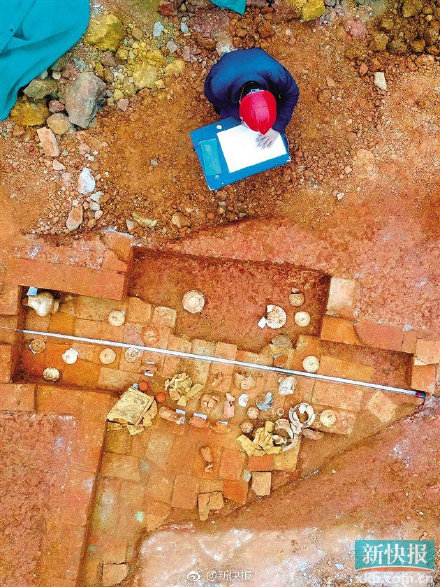
On January 6, an ancient tomb was found in the construction site of an infrastructure site on the south campus of Sun Yat-sen University. New express data map
According to the report of Science and Technology Daily on January 8th, the archaeological excavation is located in the east dining hall project site of the south campus of Guangzhou Campus of Sun Yat-sen University, and the site excavation has basically ended.
On January 7th, it was confirmed by Guangzhou Institute of Cultural Relics and Archaeology that 13 tombs and 1 water well were found in this excavation, including 1 tomb in the Eastern Han Dynasty, 2 tombs in the Ming Dynasty, 10 tombs in the Qing Dynasty and 1 water well in the Qing Dynasty. Among them, the three Han and Ming tombs numbered M1, M2 and M3 preliminarily judged that the cultural relics were of Grade B (important) and the preservation status was Grade B (generally preserved).
Because the excavation site of the ancient tomb is located in the canteen project site, some students ridiculed that "they have eaten on the ancient tomb for four years".
According to the above report, in fact, this is not the first time that Sun Yat-sen University has discovered an ancient tomb: on January 10, 1961, Yangcheng Evening News disclosed that the archaeological teaching and research group of Sun Yat-sen University had discovered a tomb in the Western Han Dynasty; In November of the same year, Sun Yat-sen University recorded that the archaeological teaching and research group of Sun Yat-sen University excavated a brick tomb of the Eastern Han Dynasty in the former Gaogang Stadium in the east campus. In April 1981, a tomb of the Eastern Han Dynasty was discovered at the construction site of the Audio-visual University in the southeast area of Sun Yat-sen University.
Colleges and universities in Xi ‘an: "The mood of attending classes is like going to the grave."
As a city with a history of more than 3,100 years, a history of more than 1,100 years, and 13 dynasties have built their capitals here, it seems that it is not news to dig an ancient tomb in Xi ‘an.
In this regard, the western network once commented that there are more than two in Xi’ an — — There are many colleges and universities, and there are many ancient tombs, so all colleges and universities in Xi ‘an are embarrassed to say that they are Xi ‘an schools … … There is a saying circulating on the Internet: "The mood of attending class is as heavy as going to the grave", which seems to have a historical origin, because all colleges and universities in Xi ‘an are "ancient tombs".
According to public information, the latest news of the excavation of ancient tombs in colleges and universities in Xi’ an occurred in June 2017.
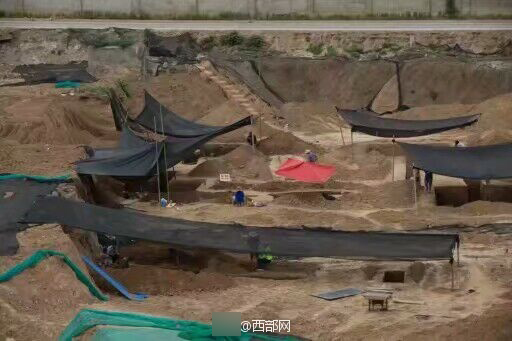
On June 22, 2017, a construction site on the campus of Huaqing College of Xi ‘an University of Architecture and Technology is now an ancient tomb. Weibo @ Western Network Data Map
According to the report of the Western Network at that time, on June 22, 2017, an ancient tomb was discovered at a construction site on the campus of Huaqing College of Xi ‘an University of Architecture and Technology. According to an insider at the construction site, the ancient tomb was discovered in January and February, and then immediately reported to the relevant departments to start the protection mechanism.
According to Shaanxi Media Network, on June 26, 2017, the reporter interviewed the relevant personnel of Xi ‘an Institute of Cultural Relics Protection and Archaeology, and got a response: an ancient tomb was indeed found near Huaqing College of Xi ‘an University of Architecture and Technology, but the specific location was not on campus, but on the infrastructure site on the east side of the school.
According to the report, it has been initially determined that this is a small and medium-sized tomb group in the Han and Tang Dynasties; The cultural relics unearthed from the Han tomb include five baht, fifty springs, copper cauldrons, copper rings, pottery pots, pottery warehouses, pottery casks and iron swords. Cultural relics such as tower pots, pottery figurines and bluestone epitaphs were unearthed from the tombs of the Tang Dynasty.
Combing the previous public reports, it is found that many Xi ‘an universities, such as Xi ‘an University of Posts and Telecommunications, Xi ‘an University of Finance and Economics and Shaanxi Normal University, have all become the protagonists of ancient tomb news.
In this regard, Liu Daiyun, who has been engaged in field archaeological excavation and research in the Sui and Tang Dynasties for a long time, said in an interview with Sanqin Metropolis Daily in 2014 that "the southern suburbs of Xi’ an are densely populated with ancient tombs. Basically, hundreds of tombs can be found in every campus during construction."
Nanjing University: There is a large tomb hidden at the level of the Imperial Mausoleum.
Similar to Xi ‘an, Nanjing, known as "the ancient capital of the Six Dynasties" and "the city of the Ten Dynasties", is also a famous historical city where ancient tombs have been excavated many times on university campuses.
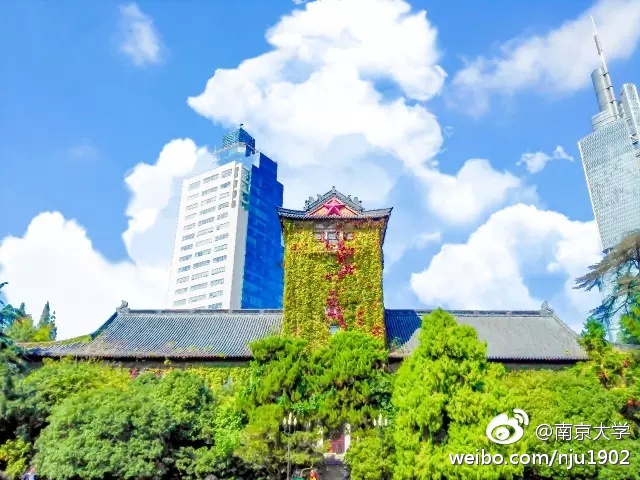
Nanjing University North Building Weibo @ Nanjing University Data Map
According to the records of official website of Nanjing University, in 1972, the remains of the bell tower were dug up in the campus of Nanjing University, and there was a mausoleum of the Eastern Jin Dynasty hidden below. Mr. Jiang Zanchu, a predecessor of Nanjing cultural and art circles and professor of history department of Nanjing University, personally experienced the archaeology of Dongjin Tomb in the North Park of Nanjing University in 1972. In his Collection of Historical Archaeology of the Middle and Lower Reaches of the Yangtze River, he recalled the archaeology of the Mausoleum that took place on the campus of the university.
According to the article, the Eastern Jin Mausoleum in the North Park of Nanjing University belongs to which emperor, and some scholars have used the method of exclusion to make textual research. Luo Zongzhen and Wang Zhigao, two archaeologists of the Six Dynasties, made an in-depth analysis in their book Cultural Relics of the Six Dynasties according to the factors such as the burial year and the female burial, and pointed out that the tomb owner of the Eastern Jin Dynasty in Nanda Beiyuan was probably Si Marui, the founding emperor of the Eastern Jin Dynasty and the Emperor of the Jin Dynasty.
According to the report of Jinling Evening News in February 2017, in addition to Nanjing University, ancient tombs have been unearthed in the campuses of Nanjing Agricultural University, Nanjing Forestry University and Nanjing University of Science and Technology in recent decades.
Among them, Liu Xiaoping, a researcher in the history of Ming Dynasty, said in an interview that part of the campus of Nanjing Forestry University was once the family tomb of Xu Da, the founding hero of Ming Dynasty and the king of Zhongshan. As early as 1969 and 1976, the tombs of Xu Da’s third generation Sun Xuqin and Xu Da’s fifth generation Sun Xubi were discovered outside the campus of Nanjing Forestry University. The bodies of Xu Kui’s tomb were still well preserved, and rich cultural relics were unearthed in both tombs.