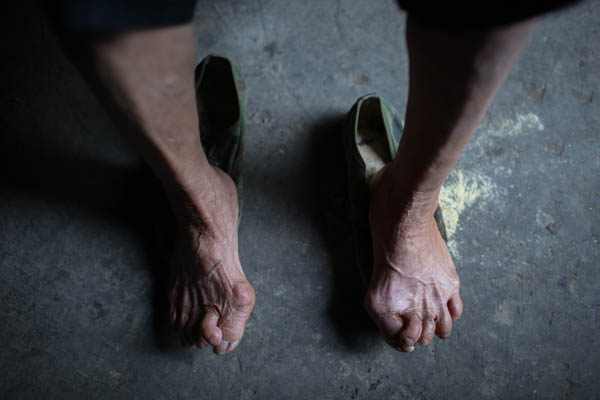
November 16, 2014, daxin county, Guangxi. Huang Min shallow took off his shoes, twisted feet exposed, she said, has been 30 years.
In November 2014, Huang Chunpu, a villager from Sanhe Village, showed his deformed hand near the lead-zinc ore dressing plant in daxin county, Guangxi. The Paper reporter Quan Yitu
The 74-year-old Huang Chunpu is sitting on the edge of the chariot. Whenever it is windy and rainy, his hand joints are painful. The first joints of his index finger and middle finger have been deformed and twisted into an acute angle with his thumb.
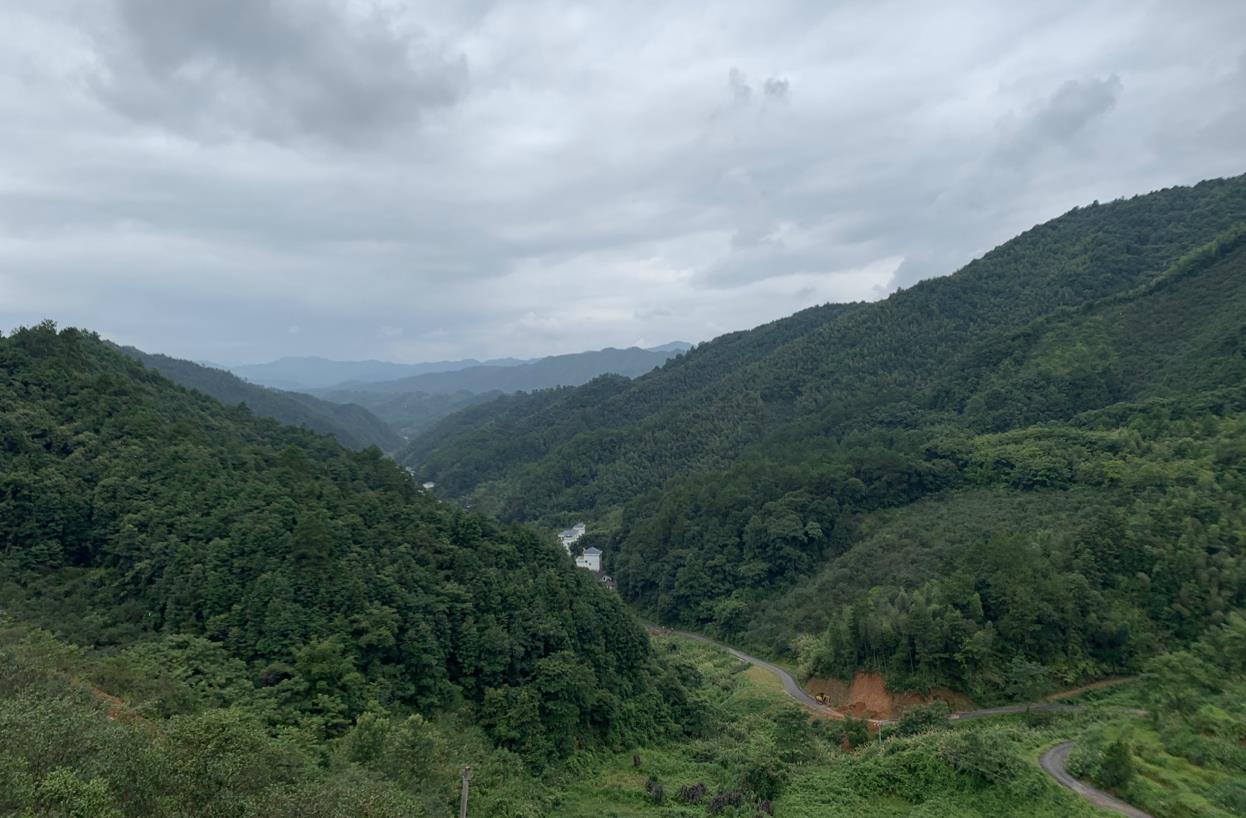
Karst landforms in southwest Guangxi are a paradise for tourists, but for people in Changtun, Sanhe Village, Wushan Township, daxin county, Guangxi, they are just stone mountains that are too barren to root eucalyptus.
A state-owned medium-sized lead-zinc mine built in the 1950s once brought prosperity to this small village on the Sino-Vietnamese border, but 50 years later, with the depletion of mineral resources, people who stayed in the village were constantly found with bone pain. On the eve of the bankruptcy of lead-zinc mine in 2001, a lawsuit between villagers and the mine revealed the secret of more than half a century of deep-buried soil-the waste water from sewage drains flooded farmland, which made the cadmium content in rice exceed the standard by 11.3 times.
In 2005, the environmental pollution incident of Daxin lead-zinc mine was instructed by Wen Jiabao, then Prime Minister of the State Council. The government of Guangxi Zhuang Autonomous Region organized experts to conduct a comprehensive investigation on the pollution sources and local water, soil and crops, and the Health Department organized medical departments to conduct physical examinations on the villagers. However, in the past nine years, soil remediation and cadmium removal treatment have come to a standstill, and the results of physical examination at that time were also kept secret. The villagers were poor and sick in the dilapidated buildings on the ground that had been emptied, and the people with bone pain insisted that they were victims of pollution. They frequently petitioned with reports of cadmium exceeding the standard in their own medical examinations.
Relevant persons from Guangxi Zhuang Autonomous Region Institute of Occupational Disease Prevention and Control who organized the physical examination told The Paper that the report held by the villagers was not scientific, but as of press time, the hospital responded to The Paper’s interview request for obtaining the medical examination results on the grounds that the person in charge could not be contacted and that "the medical examination information may not be made public".
On November 19th, two villagers, Wu Shimin and Huang Guiqiang, sent a public application for medical examination information to Guangxi Health and Family Planning Commission.
Cadmium in cultivated land exceeded the standard by nearly 30 times.
It is 143 kilometers westbound from Nanning to Daxin County, and then turns to the northeast. The provincial road changes to the county road for 21.7 kilometers, and the Changtun lead-zinc mine area is surrounded by mountains.
According to public records, after the founding of New China, Guangxi 437 Geological Team discovered lead-zinc deposits in Changtun, with a cumulative proven lead-zinc reserve of nearly 270,000 tons, which is a medium-sized deposit. In 1954, Daxin lead-zinc mine was built. At first, it was a state-owned enterprise under the former Ministry of Metallurgy, and then it was placed under the direct management of Guangxi Metallurgical Department.

November 16, 2014, daxin county, Guangxi. Most miners have moved out of the mining area. Wu Zhengyang, a retired worker from Daxin Lead-Zinc Mine, and his wife Huang Qiuying live in the family building of the mining area.
On November 16th, 2014, in daxin county, Guangxi, Wu Zhengyang, who retired from Daxin Lead-Zinc Mine, and his wife Huang Qiuying still lived in the family building of the mining area, and most of the miners moved out of the mining area. The Paper reporter Quan Yitu
Nowadays, the prosperity is like a bubble. Facing the empty and decaying playground and the bombed-out cinema, the miner’s wife, Huang Qiuying, 52, often feels disorganized in time and space: in those days, the crowd was bustling, and villagers in Wushan Township, 10 miles away, often watched the movie "White-haired Girl" with flashlights after dinner. Free tickets were the privilege of miners, and villagers who tried to evade tickets were pulled down by the doorman as soon as they climbed onto the windowsill.
Changtun is located in the southeast and downstream of the lead-zinc mine area, which is divided into four concentrated residential blocks, of which the nearest fourth production team is only a hundred meters away from the mineral processing workshop, facing each other across the cultivated land.
Cadmium exists in lead-zinc mine, but when Daxin lead-zinc mine is mined, only two metals, lead and zinc, are recovered, and the rest symbiotic metals are discarded in tailings, which makes the cadmium content in tailings much higher than its grade in ore.
There are three drainage ditches in the production area of the mining area, one of which is a closed culvert leading from the mineral processing workshop to discharge toxic sewage. The sewage in this ditch is directly discharged into the tailings reservoir of the mining area, and there is an open ditch on the right side of the tailings reservoir to discharge the overflow sewage in the reservoir. Due to the serious dissolution of rocks around the reservoir bank, the reservoir water leaks sideways in a wide range and in many directions. Another sewage ditch introduces the "Naming Canal" used by villagers to irrigate farmland.
Heavy metals carried by sewage accumulate silently in farmland until the "magic" attacks.
Wu Shimin, 65, remembers that in the 1960s or so, villagers discovered that the rice harvest was not good, and "it died when it grew to a piece." However, during the period when the industry was "on the move", the villagers’ resistance mostly ended in compensation from a few people in the mine.
When the minerals are on the verge of exhaustion and the benefits are declining, everything becomes inadequate. The contradiction finally broke out after a large-scale rice harvest in the 1990s.
"The seedlings are all dead. Let them look at the zinc mine. They ignored it. Later, they found the county environmental protection department and the leaders ignored it. They said that it was our own interception of the sewage ditch and the introduction of sewage irrigation. " Wu Shimin was the leader of the fourth production team in Changtun at that time. He remembered that someone in the mine "warned" him to "make trouble with the public security to arrest you again".

November 17, 2014, daxin county, Guangxi. In 1999, Wu Shimin’s group filed a lawsuit with the Nanning Intermediate People’s Court and filed a civil lawsuit with Daxin Lead-Zinc Mine on the cadmium pollution incident. The lawsuit went through the first and final trials and lasted for two years, and received economic compensation and land improvement expenses totaling more than 322,000 yuan, including lawyer’s fees and other miscellaneous fees, and villagers paid less compensation.
In 1999, villagers such as Wu Shimin sued Daxin lead-zinc mine to Nanning Intermediate People’s Court.
"I really can’t swallow this tone, then go to court." In 1999, Wu Shimin summoned 200 villagers from the Fourth Production Team, each of whom raised funds for 280 yuan, and sued Daxin Lead-Zinc Mine to the Nanning Intermediate People’s Court.
The secret sealed in the soil for half a century was uncovered. In 2000, Guangxi Institute of Environmental Geology was entrusted by the court to investigate the polluted farmland in Changtun. The report showed that 34 mu of cultivated land (part of the fourth production team in Changtun) had been polluted, and the main pollutants were lead, zinc, cadmium and mercury. According to the then-implemented Water Quality Standard for Farmland Irrigation (GB5084-92), the cadmium content in the first-class water for farmland irrigation should be less than 0.005mg/l, while the cadmium content in the irrigation water sample is 0.087 mg/l, which means that it exceeds the standard by 17.4 times. However, the highest cadmium content in the soil samples exceeded the standard by 29.1 times. It is worth mentioning that the appraisal agency refers to the third-class soil standards. If the cadmium content in the soil samples is less than 0.6mg/kg, the highest cadmium content in the soil samples exceeds the standard by 48.5 times.
Since then, the court’s judgment shows that, after testing, the cadmium content of rice in the polluted area is 11.3 times higher than the national standard.
The villagers’ rights protection experiment ended in success. In September, 2001, the Higher People’s Court of Guangxi Zhuang Autonomous Region awarded Daxin Lead-zinc Mine more than 320,000 yuan in economic compensation and land improvement fees for the fourth production team in Changtun, and limited daxin county Lead-zinc Mine to control the sewage facilities according to the national sewage standards within three months.
The above economic compensation was implemented in that year. However, at the end of 2001, Daxin lead-zinc mine was approved by the government of Guangxi Zhuang Autonomous Region for bankruptcy due to the exhaustion of its mineral resources. This state-owned mine was lost on the eve of the collapse, leaving an unfinished mess.
Until 13 years later, Zhao Shaolin, deputy director of daxin county Environmental Protection Bureau, admitted to The Paper that due to the limited financial resources at the county level, the underground sewage of the mine, the heavy metal pollution source of Changtun cultivated land, has not been blocked so far. This year, the central government just approved a special fund for mine treatment of 20 million yuan, but the project is still in the early stage of feasibility study and environmental assessment.

November 18th, 2014, daxin county, Guangxi.
In daxin county, Guangxi, red and yellow marks can be seen on the bare hillside. The Paper reporter Quan Yitu
The Paper goes upstream along the irrigation water source of Changtun, and the water near the tailings pond is turbid red and yellow, and the hillside is washed out with yellow marks by the waste ore wrapped in heavy rain. The cultivated land of Huang Guiqiang’s family is less than half a meter from the horizontal distance of this irrigation canal.
Chen Nengchang, a researcher at Guangdong Institute of Ecological Environment and Soil, has long been concerned about cadmium. In his view, this heavy metal is special and difficult-it is highly mobile, and it is easy to enter the soil, be enriched by plants and then enter the human body through the food chain.
The highest urinary cadmium of "patients with bone pain" exceeded the standard by nearly 5 times.
Since 2000, Huang Guiqiang has been entangled in a "strange disease" and lost his ability to work: the joints of his hands and feet are swollen and painful, and he can’t move when he is sick. Nowadays, his hands protrude from the wrist to the back of his hand, and his palms are deformed and cannot be held normally.
At about the same time, his second brother, Huang Fuqiang, also suffered from this disease, and they often relied on painkillers to get through the onset. His eldest brother Huang Jinqiang died in 2013 after 10 years of paralysis.

November 21, 2014, daxin county, Guangxi. On November 21, 2011, 60-year-old Huang Fuqiang became ill, and his body was in unbearable pain. He was lying on the couch with a sad face.
On November 21st, 2014, 60-year-old Huang Fuqiang fell ill and suffered from unbearable physical pain. He was lying on the couch with a sad face. The Paper reporter Quan Yitu
The Paper got an inspection report from Guangxi Institute of Occupational Disease Prevention and Control on 46 villagers in Changtun in March, 2001. Huang Guiqiang’s urine cadmium index was 24 micrograms per liter, while the critical value of urine cadmium was set at 5 micrograms per liter in Diagnostic Criteria and Treatment Principles of Occupational Cadmium Poisoning GB7803-1987. According to this standard, urine cadmium usually exceeds this value when chronic cadmium poisoning occurs. According to the report, the urinary cadmium index in Huang Fuqiang is 4.29 micrograms per liter, while that in Huang Jinqiang is 11.25 micrograms per liter.
According to the statistics of the above-mentioned 46-person inspection report in The Paper, 20 people (about 43.48%) have urine cadmium content above 5μg/L, and the overall average urine cadmium content is 4.95μg/L, which is close to the upper limit of 5 μ g/L.. However, it is not clear whether the sample of this test is statistically significant.
In the humid southern countryside, backache and leg pain are considered to be caused by the weather and labor. Wu Jinjie, who started to be a village doctor in 1969, said that the patients who saw him the most were those with bone pain, and they often asked Wu Kai to take several plasters to deal with the pain.
In 1987, when Huang Guiqiang was the young and strong deputy director of the village committee in Changtun, Nanning Regional Metallurgical Bureau, regional epidemic prevention stations and county epidemic prevention stations and other relevant personnel went to Changtun to take water, soil samples and blood and urine samples from some elderly people in the village.
His mother participated in the sampling inspection. After the test, a group of elderly women in the village were asked to go to the mine workers’ hospital for infusion in batches, "for more than ten days". It was not until many years later that Huang Guiqiang knew that it was "cadmium drive treatment", and the villagers knew nothing about the results of that test.
Huang Guiqiang couldn’t expect that after more than 20 years, bone pain also broke out in his hands and feet, and now he is trapped in a body identified as "second-degree disability".
In 2013, a professor from a university in Guangxi took students to randomly select 15 villagers of different ages (6 males and 9 females) in Changtun to investigate and analyze the health effects of cadmium pollution on residents. The results showed that 4 people had hyperosteogeny (osteoarthropathy), 11 people had symptoms of bone pain, 10 people found obvious brown rings around their eyeballs, and 4 people had swollen joints. However, the professor reminded The Paper that "the sample size of this survey is small and can only be used for reference."
According to the diagnostic criteria of "painful disease" in Japan, it is generally believed that osteoporosis and osteomalacia are typical manifestations of severe cadmium poisoning, but the relationship between osteoarthropathy and cadmium poisoning remains to be studied. A paper published in 2013 by Li Jimeng, deputy chief physician of Changsha Center for Disease Control and Prevention, holds that long-term exposure to low-concentration cadmium can lead to increased calcium excretion, which leads to increased bone load and aggravation of hyperosteogeny.
According to Hao Fengtong, chief physician of the Department of Occupational Diseases and Poisoning Medicine of Beijing Chaoyang Hospital, the "painful disease" is related to the background of malnutrition and calcium deficiency in Japan after the war. "The present manifestations of cadmium poisoning may not be like that at that time", but he also believes that it is not appropriate to regard bone hyperplasia as the inevitable manifestation of cadmium poisoning.
The 81-year-old Huang Min is shallow, her hands and feet are deformed, and her spine is bent. It is inconvenient for her to walk. She has to take a rest when she walks with her legs in her hands. The Paper reporter Quan Yitu
The Paper interviewed 18 villagers who claimed to have symptoms of bone pain in Changtun. Most of their pain parts were from the waist down to the thigh, the joint of the calf to the sole of the foot, or the lower arm to the palm of the hand, and they were swollen and deformed to varying degrees from the outside.
For example, 82-year-old Huang Minshan’s big toe joint is swollen, and his toes curl inward and deform. She once participated in the physical examination in 2001, and the urinary cadmium index was 16.95 μ g/L; In this list of 46 people, two people have passed away so far. Besides Huang Jinqiang, there is also an old man named Wu Minquan whose urine cadmium value is 7.8 μ g/L. Her family told The Paper that Wu died in about 2004, and they couldn’t explain the cause of Wu’s death. "One day I was still herding cattle, and the next day I suddenly died"; In this list, the youngest one was born in 1991, and now he has moved to other places. His neighbors in the village recalled that the child had symptoms of foot pain when he was 5 to 6 years old. "He cramped with pain, cried when he was in pain, and heard his crying when he slept at night." The aforementioned tests showed that his urinary cadmium index was 7.44 μ g/L.
Cadmium exposure is divided into occupational cadmium exposure and environmental cadmium exposure. The Paper learned from his visit that Huang Minshan and Wu Minshan are both villagers, who make a living by farming. There is no possibility that cadmium in their bodies comes from occupational cadmium exposure.
However, Hao Fengtong told The Paper that excessive cadmium in urine is not a single indicator to judge cadmium poisoning, and the target organ of cadmium is the kidney, which needs to be comprehensively judged by combining whether there is renal damage such as renal tubular reabsorption dysfunction and clinical symptoms such as low back and limb pain.
"Cadmium Exposure Physical Examination Results" has not been made public for 9 years.
Guangxi Institute of Occupational Disease Prevention and Control is a qualified institution for cadmium poisoning identification in this area. The above-mentioned inspection report in 2001 came from this hospital, and the villagers spontaneously conducted tests at their own expense. However, the sample of the list is small, and there is only a single indicator of urinary cadmium. It is impossible to establish the association of cadmium poisoning only by this report.
In fact, there is another test report with more complete samples and data issued at the end of 2005, which records the health status of cadmium exposure of villagers in Changtun in detail. Now it is dusty in the reference room of relevant departments.
This report originated from a visit to Beijing by four villagers’ representatives from Changtun in 2005. Huang Tuanbao, one of the four petitioners, told The Paper that the motive of the petition was that "the historical problem has not been solved, and private companies have come in to plan to open mines again".
A report published in "Chongzuo News" in 2004 said that Nanning Jin Tao Tendering Co., Ltd. obtained the prospecting license of Changtun Lead-zinc Mine in 2004, and when it carried out the exploration work on August 17 of that year, "it was blocked by some villagers in Changtun … Since August 20 this year, the people in this village have dug 14 mines blocked by the county government according to law for indiscriminate excavation."
Wu Shimin told The Paper that the villagers did engage in private mining. They believed that the prospecting company was mining in the name of prospecting. "Before the pollution problem was solved, we started digging again. Since you are mining, we will also mine.".
The problems reflected by the petition of four villagers were instructed by Wen Jiabao, then Prime Minister of the State Council. A summary of the meeting of the People’s Government of Guangxi Zhuang Autonomous Region (Zheng Gui Yue [2005] No.110) obtained by The Paper shows that, in order to implement the spirit of Wen Jiabao’s instructions, on November 14th, 2005, Lu Bing, then chairman of the autonomous region, led the heads of relevant departments of the autonomous region to Daxin to investigate the environmental pollution of lead-zinc mines, and held a special meeting in Chongzuo on November 16th to study how to further investigate and deal with the environmental pollution of lead-zinc mines in Daxin.
This meeting proposed to stop the prospecting activities of Nanning Jin Tao Tendering Company; Organize relevant experts to conduct in-depth investigations on pollution sources and local water, soil and crops; The Health Department organizes medical departments to conduct free physical examination on whether pollution affects the health of the people in Changtun, and study and put forward treatment measures; And the civil affairs department gives some relief to the villagers who have lost their ability to work because of the pollution of mining and beneficiation.
The Paper confirmed from many departments that at the end of 2005, it was the Guangxi Institute of Occupational Disease Prevention and Control that led a team to Changtun to have a physical examination for the villagers. The Paper contacted a doctor who participated in the physical examination. He refused to disclose the results of the physical examination in that year, but only stressed that "the physical examination results were not as serious as the villagers described".
The Paper consulted a paper entitled "Investigation on the Health Status of Residents Exposed to Cadmium in a Lead-zinc Mine in Guangxi" written by doctors of Guangxi Institute of Occupational Disease Prevention and Control and published in China Public Health in 2010. The subject, time and samples of the investigation were consistent with the physical examination of the villagers in Changtun in 2005. The paper disclosed some survey data: among the 361 permanent residents tested, 195 people had urinary cadmium exceeding the limit of 5 micrograms per creatinine, and the highest value was detected. The investigation shows that renal tubular reabsorption dysfunction increases in cases where urinary cadmium exceeds 5 micrograms per creatinine.
However, the author of this paper refused to check with The Paper about the relationship between the article and the physical examination report of Changtun in 2005. The reporter tried to contact Guangxi Provincial Institute of Occupational Disease Prevention and Control to obtain the above-mentioned medical report information, but as of press time, he did not get a reply from the other party.
"Cadmium Poisoning": An Unspeakable Secret
For the protagonist of this "public case", the villagers in Changtun, daxin county, this is the most helpless dilemma-physical examination information is not only the basis for them to know their own health status and symptomatic treatment, but also the evidence for litigation and claims. Now, the self-inspection report they are holding is not "recognized", but there is no way to know the "real situation".
According to Wang Zhenyu, deputy director of the Public Decision Research Center of China University of Political Science and Law, both the Guangxi Health Department (now the Guangxi Health and Family Planning Commission) which organized the physical examination and the Guangxi Occupational Disease Prevention and Treatment Institute which carried out the physical examination have the obligation to inform the villagers of the physical examination information.
"The medical examination hospital has concluded a civil legal relationship with the villagers and should inform the villagers of the testing information; The government not only has the administrative obligation to disclose the test results, but also should issue treatment opinions according to the situation. " He said to The Paper.
The responsible person of the Propaganda Department of daxin county Government explained to The Paper that the information on heavy metal pollution could not be made public "because of social stability".
It is worth mentioning that in April, 2014, the first soil pollution survey bulletin in China announced that cadmium pollution was the largest among the eight heavy metal pollution, and the over-standard point reached 7%. At the same time, the cadmium content has generally increased throughout the country, with an increase of more than 50% in the southwest and coastal areas.
However, the impact of such "universal and increasing cadmium pollution" on human health is still an unspeakable "secret".
Many cadmium pollution researchers interviewed also told The Paper that this was a "minefield", and even when they were writing their papers, they often hid the relevant data, or treated them vaguely or anonymously.
The "painful disease" incident in Japan is recognized as a classic case of studying cadmium pollution and cadmium poisoning. Chen Nengchang told The Paper that the level of cadmium pollution in some areas of China was comparable to that of Japan in that year, and there were also cases of suspected "painful disease" in unofficial data, but the "painful disease" has not been confirmed by the government, and the cases of suspected "death from cadmium poisoning" have not been confirmed.
However, Shang Qi, a researcher at China CDC, once pointed out in an interview with Caixin reporter that China did not observe that "painful disease" was related to the relatively low background value of cadmium content in China soil and the large number of young people leaving the village to enter the city; In addition, the outbreak of "painful disease" in Japan was when the people were malnourished after the war, and when the cadmium damage in China was serious, people did not worry about food and clothing after the reform and opening up.
Replanting vegetables on poisonous land

November 17, 2014, daxin county, Guangxi. The local government banned villagers from planting crops, and there was no vegetable market near the village, so they had to open a wasteland at the door of the house, lay a layer of soil and grow vegetables for their families to eat.
The local government banned villagers from planting crops, and there was no vegetable market near the village, so they had to open a wasteland at the door of the house, lay a layer of soil and grow vegetables for their families to eat. The Paper reporter Quan Yitu
Times have changed. After the petition in 2005, only the following things have been changed in Changtun: since 2006, polluted fields have been banned from farming; The daxin county Municipal Government will distribute rations at a rate of 30 kg/m per capita every month for 8 months a year; There are fewer and fewer people to support in this land. Young people, including middle-aged people who are still able to work, go out to work, leaving only the old and the young who are getting sick and sick.
For example, at Huang Guiqiang’s home, only he and his octogenarian old menstruation stay behind, and his wife in her fifties goes to Shenzhen to work with her son, and can come back about once a year during the Spring Festival.
Hao Fengtong said that the half-life of cadmium is about 15 to 20 years, and its natural excretion from the body is very slow. At present, there is no ideal drug to drive cadmium, but symptomatic treatment is often taken in clinic to improve the quality of life of patients. This treatment needs to last for about 3 to 5 years.
For this poor and sick village, such treatment is almost extravagant. Some villagers interviewed have been taking cheap hormone drugs for a long time to stop the pain, while others who are slightly ill have picked up herbs or put on some plasters to deal with it.
The Paper interviewed the leaders of daxin county Municipal Government, County CDC and County People’s Hospital to ask about the medical treatment of villagers in the cadmium-polluted area in Changtun after 2005. They all replied that they had not received any arrangement or implemented such free projects from their superiors.
What is even more worrying is that the source of cadmium pollution has not been blocked, and waste mineral water containing cadmium is still polluting cultivated land, although these cultivated lands are required to be banned from planting. However, when The Paper visited, he saw that some villagers planted vegetables, cassava and corn in their own fields. "If you don’t plant it, where will those (distributed) rations be enough to eat?" They explained that it was the old way to pick some new soil from the outside and cover it.
This means that "old wounds have not healed, and new wounds have been added", and cadmium metal may accumulate in the human body along the original path-food chain. The above-mentioned health department confirmed that there was no new physical examination on the health status of villagers exposed to cadmium in 9 years.
In 2009, Wu Shimin was told by the township government to move out of his old house in the village. Because of mining, 19 houses in Changtun have been mined out and become dangerous houses. He had to stay in the workers’ dormitory in the mining area-besides him, there lived a couple of weak miners, an old man who was paralyzed all the year round and a middle-aged man who lived alone, and other miners all made their own living separately.
Suspicion and fear of cadmium poisoning, anger and powerlessness of poverty and illness are intertwined in Changtun village. Most villagers think that the cost and risk of litigation are too great, and they are unwilling to spend money to fight another lawsuit; Some villagers pinned their hopes on petitioning, such as Huang Guiqiang. The last time they went to Chongzuo to petition was in April this year, but the petition letter was as heavy as a stone; "What’s the use? Petition in Beijing in 2005 can’t solve the problem. Other villagers said that they thought it would be more affordable to change the travel expenses and accommodation fees for petitioning to a few bottles of hormone drugs.
In 2014, the daxin county Municipal Government’s work report mentioned that "accelerating the treatment of heavy metal pollution in Daxin lead-zinc mine area". However, when The Paper went to the daxin county Municipal Government for an interview on November 21, the relevant person in charge of the Propaganda Department was somewhat unfamiliar with this topic. "Daxin lead-zinc mine, wasn’t it a long time ago?" He said to himself, "the leaders of health and environmental protection bureau don’t know how many dials have been changed."
On November 23rd, when most of China was covered by winter, the temperature in Daxin, southwest Guangxi was still 18 to 21 degrees Celsius. The rural life surrounded by green hills and heard of by chickens and dogs must satisfy the imagination of urbanites on pastoral songs, but this is only the appearance. You will soon notice that the weeds in the banned cultivated land have turned yellow.