26 provinces’ National Day Golden Week tourism data are released, which provinces earn more?
This year’s Mid-Autumn National Day holiday ushered in the "hottest National Day Golden Week in history". As one of the main driving forces to promote consumption, tourism consumption performed well in this Golden Week and achieved the expected growth. So, in this golden week, which provinces earned more?
Up to now, 26 provinces have released National Day tourism data, of which 22 provinces have comparable data (Hubei, Chongqing, Shanxi and Hebei provinces have released the number of tourists and ticket revenue in major scenic spots, while others have not released specific figures). From these provinces, Henan received the largest number of tourists, while Jiangsu achieved the highest tourism revenue.
Henan, Anhui and Jiangsu are leading the way in receiving tourists.
According to the data center of the Ministry of Culture and Tourism, during the eight-day Mid-Autumn Festival and National Day holiday, the number of domestic tourists was 826 million, an increase of 71.3% year-on-year according to comparable caliber, and an increase of 4.1% compared with 2019 according to comparable caliber; Domestic tourism revenue reached 753.43 billion yuan, up 129.5% year-on-year according to comparable caliber, and up 1.5% compared with 2019 according to comparable caliber.
Judging from the number of tourists received by each province, Henan ranks first among all provinces. Henan Provincial Department of Culture and Tourism announced that from September 29th to October 6th, the province received 84.801 million tourists. Followed by Anhui and Jiangsu, which received 72.86 million tourists and 71.1848 million tourists respectively.
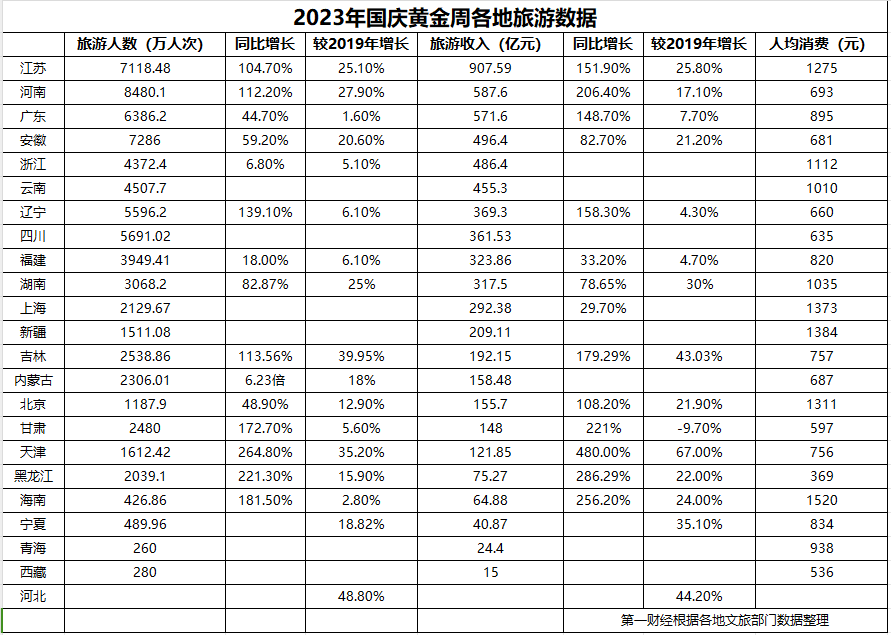
Among the 26 provinces that have published data, 6 provinces have received more than 50 million tourists, namely Henan, Anhui, Jiangsu, Guangdong, Sichuan and Liaoning. The last three provinces received 63.862 million tourists, 56.9102 million tourists and 55.962 million tourists respectively.
The total number of tourists received by these six provinces reached 406 million, that is to say, the number of tourists received by six provinces including Henan, Anhui, Jiangsu, Guangdong, Sichuan and Liaoning accounted for nearly half of the country.
Chen Gankang, a professor at the School of History, Culture and Tourism of Sichuan Normal University, dean of the Institute of Labor and Practice Education, and president of the Sichuan Tour Guide Association, told CBN that the large number of tourists on National Day this year proves that tourism is still just needed and is still a leading industry that drives the development of the service industry.
Not only that, but he also believes that during the Golden Week, people pay high attention to tourism, and travel-related issues are easily amplified, so the Golden Week is often easy to become a complaint week. However, there are basically no vicious complaints about travel during the Golden Week this year, and the whole market is peaceful, which proves that the tourism industry is operating normally, and the tourism market is not only recovering in quantity, but also improving in management level and service quality.
Dai Bin, president of China Tourism Economic Research Institute, believes that from the micro-structural indicators such as the average travel distance of tourists, the average recreation radius of destinations, the tourism consumption structure, the proportion of go on road trip, and the satisfaction of tourists, the past three years of COVID-19 epidemic have indeed passed, the marginal effect of the normalization policy of travel and contact consumption tends to decrease, and the tourism economy has begun to enter a new normal driven by market endogenous and innovation. Under the joint action of science and technology, creativity, investment and entrepreneurial confidence, the tourism economy will steadily turn into a new stage of rational prosperity.
Who is the biggest winner?
However, Henan’s tourism revenue is not the highest.
According to the data of Jiangsu Provincial Department of Culture and Tourism, Jiangsu Province received a total of 71.1848 million domestic tourists, achieving a total tourism revenue of 90.759 billion yuan, up 104.7% and 151.9% respectively compared with 2022, and up 25.1% and 25.8% respectively compared with the same period in 2019 according to comparable caliber. Jiangsu province ranks first among all provinces with a tourism income of 90.759 billion yuan.
Up to now, following Jiangsu, six provinces, including Henan, Guangdong, Anhui, Zhejiang and Yunnan, have achieved tourism revenues of more than 40 billion yuan, temporarily ranking in the top six in China, with 90.759 billion yuan, 58.76 billion yuan, 57.16 billion yuan, 49.64 billion yuan, 48.64 billion yuan and 45.53 billion yuan respectively.
The tourism income of these six provinces reached 350.489 billion yuan, that is to say, the tourism income of six provinces including Jiangsu, Henan, Guangdong, Anhui, Zhejiang and Yunnan also accounted for nearly half of the national income.
So, who is the biggest winner?
In addition to the number of tourists and tourism income, per capita consumption is also an important indicator of tourism. According to CBN, on National Day this year, Hainan topped the list with a per capita consumption of 1,523 yuan, while the provinces that surpassed 1000 yuan were Hainan, Xinjiang, Shanghai, Beijing, Jiangsu, Zhejiang, Hunan and Yunnan, with 1523 yuan, 1384 yuan, 1373 yuan, 1311 yuan, 1275 yuan, 1112 yuan, 1035 yuan and 1010 yuan respectively.
Comparatively speaking, during the May Day holiday this year, the growth of tourism consumption was considerable.
CBN found that during the May Day holiday this year, among the major tourist provinces with more than 30 million tourists, only the per capita consumption in Yunnan increased compared with that before the epidemic, including the per capita consumption in Henan, Sichuan, Guangdong, Jiangsu and Zhejiang, which decreased compared with the May Day holiday in 2019. However, during the National Day this year, the growth rate of tourism revenue in most provinces was higher than that of the number of tourists.
For example, Tianjin received a total of 16.1242 million tourists during the Mid-Autumn National Day holiday this year, an increase of 264.8% year-on-year and an increase of 35.2% over 2019. The tourism revenue reached 12.185 billion yuan, up 480.0% year-on-year according to comparable caliber, up 67.0% compared with 2019. Whether compared with last year or compared with 2019, the growth rate of tourism revenue is higher than that of the number of tourists.
Not only that, CBN found that during May 1 this year, the provinces with per capita consumption exceeded 1000 yuan, including Zhejiang, Shanghai, Beijing and Hainan, while the provinces with per capita consumption exceeded 1000 yuan on National Day this year included Hainan, Xinjiang, Shanghai, Beijing, Jiangsu, Zhejiang, Hunan and Yunnan.
Chen Gankang said that tourism consumption is more rational. Although the price of tourism in various places has been raised due to the relationship between supply and demand, it is not large, because the market is more rational. When the price is found to be high when booking, tourists will take the initiative to change their destinations, so as to balance the price through the relationship between supply and demand in the market.
Chen Gankang said that this year’s National Day consumption has increased to a certain extent, and tourists spend more on catering and accommodation. With the recovery of the real economy, there is still room for further growth in the tourism industry. At present, domestic tourism should be fully restored, but the outbound and inbound markets are recovering slowly, so there is still room for growth as a whole.